PDF Download Meta-Halakhah: Logic, Intuition, and the Unfolding of Jewish Law, by Moshe Koppel
Many people will feel so hard when seeking guide from immigrant. The much distance and difficult place to obtain the resources become the large troubles to encounter. However, by seeing this website, you can locate Meta-Halakhah: Logic, Intuition, And The Unfolding Of Jewish Law, By Moshe Koppel easily. Why? We are the library based internet that come by the million titles of guides from many countries. Simply locate the search as well as discover the title. Obtain also link download when you have the book. If this book is your choice, you can straight get it as yours
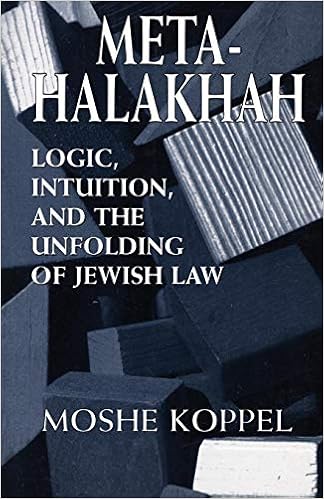
Meta-Halakhah: Logic, Intuition, and the Unfolding of Jewish Law, by Moshe Koppel

PDF Download Meta-Halakhah: Logic, Intuition, and the Unfolding of Jewish Law, by Moshe Koppel
In suiting the brand-new upgraded publication released, we involve you. We are the on-line web site that always gives a very excellent way, excellent term, and great checklists of the collections publications from several nations. Schedule as a way to spread the information as well as information regarding the life, social, sciences, religions, lots of others holds a very important rule. Book may not as the fashion when they are out of date, they will function as absolutely nothing.
As understood, many individuals claim that books are the windows for the world. It doesn't indicate that buying publication Meta-Halakhah: Logic, Intuition, And The Unfolding Of Jewish Law, By Moshe Koppel will certainly suggest that you can buy this globe. Merely for joke! Reviewing a book Meta-Halakhah: Logic, Intuition, And The Unfolding Of Jewish Law, By Moshe Koppel will certainly opened a person to think far better, to keep smile, to captivate themselves, and also to motivate the understanding. Every e-book additionally has their unique to influence the visitor. Have you understood why you review this Meta-Halakhah: Logic, Intuition, And The Unfolding Of Jewish Law, By Moshe Koppel for?
Yeas, this readies information to recognize that Meta-Halakhah: Logic, Intuition, And The Unfolding Of Jewish Law, By Moshe Koppel has exposed once more. Many individuals have been waiting for this writer works. Also this is not in your preferred publication, it will certainly not be that mistake to attempt reviewing it. Why should be question to get the new publication recommendation? We constantly refer a publication that can be required for all individuals. So in this manner, when you have to understand more regarding the Meta-Halakhah: Logic, Intuition, And The Unfolding Of Jewish Law, By Moshe Koppel that has been supplied in this site, you need to sign up with to the link that we all recommend.
Getting this book in this internet site could not lead you to stroll and also most likely to publication shop. Seeking shelf by rack will actually spend your time primarily. Yet, it well not assurances you to be effective finding Meta-Halakhah: Logic, Intuition, And The Unfolding Of Jewish Law, By Moshe Koppel Thus, you can discover it in the soft data of this book. It will certainly offer you the fantastic system of guide suggestion. You can go to the web link and go to the page to earn deal with. And now, your publication sift data of this can be your selected book and also area to read this interesting publication.
Product details
Paperback: 180 pages
Publisher: Jason Aronson, Inc. (December 1, 1997)
Language: English
ISBN-10: 1568219016
ISBN-13: 978-1568219011
Product Dimensions:
5.2 x 0.4 x 8.2 inches
Shipping Weight: 9.6 ounces (View shipping rates and policies)
Average Customer Review:
5.0 out of 5 stars
2 customer reviews
Amazon Best Sellers Rank:
#861,370 in Books (See Top 100 in Books)
Presumably, this book's intended audience, like other books of such a caliber, is not a wide one. Nonetheless, if you are someone whose thoughts oscillate between interdisciplinary topics like history, philosophy, mathematics, and Judaism --- you will almost certainly benefit from reading it.The central question explored in this book is defined by the need to reconcile the empirical/practical and the dogmatic perspectives on the nature of Halakhah, the Jewish law. The latter perspective, one that posits that the complete immutable Law was given at Sinai, is embedded within Rabbinical Judaism, and deviations from such doctrine (explicitly stated by Rambam) are not welcome in most Orthodox communities. But if one is honest and explores such matters with genuine ardor, one has to confront the question: how is it possible that the complete Law was given to Moses and Israel at a particular time and space, yet additions are still being made today and are still considered "Torah?" Koppel, in the best of said Rabbinical-midrashic tradition, manages to convince that, ultimately, these two seemingly opposing takes are convenience devices for the same normative reality.Koppel, in this book, is not trying to answer the different but related (and even more uncomfortable) question: was the original Torah (encoded in the Chumash, i.e. the Law that doesn't explicitly encompass Mishnah, Gemorah, and later developments) composed by one person, Moses, or was it created and (to a degree) added to or modified throughout subsequent generations, up to the Second Temple period (in what's academically refered to as "Priestly source")? Such questions are addressed by other writers -- Biblical scholars and historians, including those from academia, like of Biblical Archaeology Society, and curiously, more recently, the Modern Orthodox world, via Project TABS -- and are left unexplored by Koppel's book, which is focused on the philosophical and the legal, not so much the historical. (To be fair, Koppel does have a separate paper on his Bar-Ilan website, where he explores the historical composition of the Torah utilizing academic, statistically-driven approach.) In this book, nonetheless, he does posit that Halakhah started out as a prophetic insight (via Moshe Rabbeinu), yet, as centuries and millennia passed, the role of the more spontaneous prophecy had diminished in favor of structured, scribal cum-scholastic unfoldment, where modern "prophecy" is more akin to constrained intuition and (re-)interpretation of a firmly formalized Halakhah in the ever shifting context of life of an individual Jew within a Jewish community that mediates his existence in the (also changing) world at-large.It is very hard to summarize a book like this. I'll give some examples of the topics I found engrossing: Koppel's act of connecting the evolution and description of Jewish law with (presumably, Kolmogorov) complexity, paralleling Halakhah's non-modelability with Gödel's (First) Incompleteness Theorem, him touching upon artificial intelligence vis-a-vis a Jew's autonomy, liberalism versus conservatism, random living versus mechanistically adhering to dogma. Also, while many philosophers focus on the ethics and life of the atomic individual, Koppel drives at the higher-level picture -- on the evolution of the entire (Jewish) civilization, unconstrained by time and space.Central to his book is the concept of autonomy/non-modelability. Mathematically, he defines a string as modelable if it consists of a predictable component and/or random component. As an example of non-modelable entities, he provides decimal representation of computable, (irrational) numbers made up of non-random digits. Ultimately, such constructions serve to illustrate his main thesis, its animating belief/emunah: that Halakhah and its practitioners form a non-modelable system. Non-modelable phenomena are non random and possess a "beginning" but no "end:" one can get a decent approximation to their true "value" (or description), and, as time and effort progresses, this approximation can get better, but the full description will always remain unreachable, ever-unfolding.To illustrate further: decimal representations of certain transcendental (hence infinitely long and non-repeatable) numbers, like pi, are good examples of non-modelable entities, since they possess the property of being computable, non-random, while remaining non-compressible. But not all transcendental numbers are non-modelable: numbers that are made of, essentially, random digits or those generated from random processes, like Chaitin's constant, for instance, are modelable. Of the latter category it can, very roughly, be said that each digit is defined by its own, independent (random) world. Infinite strings that have structure, like rational numbers are also modelable.Though it's not the main topic of the book, merely one of the many sub-topics, his view on the Messiah is also an interesting one to me. He remains agnostic regarding the issue of the arrival of (an? the?) individual regal-human manifestation thereof, and he explicitly points this out in the book, albeit in the footnotes. What he emphasizes, though, is the idea of the Messiah both as an unfolding *process* and a *cultural threshold* of true non-modelability in Judaism. He does not define exactly how it should actually manifest itself, but, according to some of his other writings I've perused on the Web, I am deducing that he ultimately envisions something like a merger of libertarian ideas with Jewish communality. Leaving defense and economy aside, this might be embodied in a decentralized Jewish tribal/court confederation regulated by Halakhically-compatible yet secular law of the land (which, again presumably, might evolve to be more explicitly Haredi-Jewish with time... or, to the contrary, might yet become something novel). At the same time, said vision of law implies autonomy for each such Jewish community/court to conduct its affairs at the local level as it, pretty much, pleases. It might be that he even sees several "levels" of autonomy, maybe expressed through culturo-legal subsidiarity. Again, you will not find those views espoused in the book, and it is always possible that it's just my own interpretation thereof, viewed through the prism of a Zionism-friendly, idealistic evolutionist, yet I couldn't help myself but try to understand his position better, via extra reading. It is an open question whether physical Third Temple is in the cards, but such apparent position implies either limitation on the power of (future, potential) priestly class or its decentralization (might it actually make the idea of a physical king and Sanhedrin more pertinent?).Since I am a secular Jew (albeit who has studied some Jewish tradition and history) and not a mathematician (beyond having had taken a few graduate level classes in my student years at university, including those pertaining to foundations of math), it's quite possible I've made some mistakes in this review. My verdict, though, is: this book should be classified a masterpiece of modern rationalist Judaism. I also highly recommend that the curious reader take a look at other writings by the author, as I find his other viewpoints interesting also -- some of them are only slightly hinted upon in this book and deserve a separate exploration. I've only attempted to summarize something that is a scholar's entire life's work.
How can it be that all of Halakha was given at Sinai, and yetthat each generation of rabbis is able to introduce innovations? IsHalakha "all there at once" in some Platonic sense, or does it come into existence via convention as Halakhic decisors render specific rulings on specific points?Moshe Koppel thinks questions like these are insufficiently pondered and, when they _are_ asked, all too likely to receive a toe-in-the-dirt "well-umm" sort of reply. So in this slim volume he faces them head-on -- and answers them.The sole other review on this page has already revealed where Koppel is headed with his argument. So I shall simply point out what that argument is. In essence it is this: intuition precedes formalization, and the latter can never fully exhaust the former. There is no conflict between the "Platonic" and "conventionalist" views of Halakha; indeed both of them are true.Koppel supports this contention with clear and deft discussions of certain limitative results from modern mathematical logic. And (no surprise here) he acknowledges a great debt to Rav Joseph Dov Soloveitchik ztz"l.Readers of the Rav's _Halakhic Man_ and _The Halakhic Mind_ will probably enjoy this book tremendously. Indeed, it is hard not to speculate that the Rav would have enjoyed it himself.(...)
Meta-Halakhah: Logic, Intuition, and the Unfolding of Jewish Law, by Moshe Koppel PDF
Meta-Halakhah: Logic, Intuition, and the Unfolding of Jewish Law, by Moshe Koppel EPub
Meta-Halakhah: Logic, Intuition, and the Unfolding of Jewish Law, by Moshe Koppel Doc
Meta-Halakhah: Logic, Intuition, and the Unfolding of Jewish Law, by Moshe Koppel iBooks
Meta-Halakhah: Logic, Intuition, and the Unfolding of Jewish Law, by Moshe Koppel rtf
Meta-Halakhah: Logic, Intuition, and the Unfolding of Jewish Law, by Moshe Koppel Mobipocket
Meta-Halakhah: Logic, Intuition, and the Unfolding of Jewish Law, by Moshe Koppel Kindle

0 komentar:
Posting Komentar