Ebook Download
Currently, when you need a brand-new good friend to accompany you dealing with as well as resolving the difficulties, is the prospect to advise. It can accompany you any place you go advertisement you require. It's designed for soft data, so you will not really feel tough to discover and also open it. Juts open the tab and afterwards review it. This way can be done certainly after you are getting the files via this internet site. So, your task is by clicking the web link of that book to check out.

Ebook Download
Success is a selection. It's what many people state and also suggest making others be succeeding. When someone decides to be success, they will attempt large initiative to realize. Numerous means are prepared and gone through. Absolutely nothing limited, yet there is something that could b failed to remember. Seeking for expertise and experience should be in the strategy and procedure. When you always a lot more these two, you can finish your plans.
As a publication, including the sensible and careful book is the basic one to constantly remember. It needs to select as well as pick the very best words selections or dictions that could influence the top quality of guide. additionally features the easy language to be understood by all individuals. When you believe that this book appertains with you, choose it now. As an excellent publication, it offers not only the characteristics of the books that we have actually offered.
Just what should you believe more? Time to obtain this It is simple after that. You could only sit and stay in your place to get this publication Why? It is online publication shop that provide many collections of the referred publications. So, just with internet connection, you can delight in downloading this publication and numbers of books that are looked for now. By seeing the web link web page download that we have actually offered, the book that you refer a lot can be found. Merely conserve the requested publication downloaded and then you can enjoy guide to review every single time as well as location you want.
When you really feel that you're interested enough in this publication, you could get it by clicking the connect to attach directly to guide. is provided in the soft documents kinds, so you could save as well as review it in different tool. We mean that it appropriates as well as readily available to check out every time you want. Even it's in the train or every where you are, you can use the leisure for analysis.
Product details
File Size: 1442 KB
Print Length: 308 pages
Page Numbers Source ISBN: 0199640297
Publisher: OUP Oxford; Reprint edition (September 30, 2010)
Publication Date: September 30, 2010
Sold by: Amazon Digital Services LLC
Language: English
ASIN: B006BY2CAK
Text-to-Speech:
Enabled
P.when("jQuery", "a-popover", "ready").execute(function ($, popover) {
var $ttsPopover = $('#ttsPop');
popover.create($ttsPopover, {
"closeButton": "false",
"position": "triggerBottom",
"width": "256",
"popoverLabel": "Text-to-Speech Popover",
"closeButtonLabel": "Text-to-Speech Close Popover",
"content": '
});
});
X-Ray:
Not Enabled
P.when("jQuery", "a-popover", "ready").execute(function ($, popover) {
var $xrayPopover = $('#xrayPop_EDE84F04551311E99D52ED2C2FBED35C');
popover.create($xrayPopover, {
"closeButton": "false",
"position": "triggerBottom",
"width": "256",
"popoverLabel": "X-Ray Popover ",
"closeButtonLabel": "X-Ray Close Popover",
"content": '
});
});
Word Wise: Enabled
Lending: Not Enabled
Screen Reader:
Supported
P.when("jQuery", "a-popover", "ready").execute(function ($, popover) {
var $screenReaderPopover = $('#screenReaderPopover');
popover.create($screenReaderPopover, {
"position": "triggerBottom",
"width": "500",
"content": '
"popoverLabel": "The text of this e-book can be read by popular screen readers. Descriptive text for images (known as “ALT textâ€) can be read using the Kindle for PC app if the publisher has included it. If this e-book contains other types of non-text content (for example, some charts and math equations), that content will not currently be read by screen readers.",
"closeButtonLabel": "Screen Reader Close Popover"
});
});
Enhanced Typesetting:
Enabled
P.when("jQuery", "a-popover", "ready").execute(function ($, popover) {
var $typesettingPopover = $('#typesettingPopover');
popover.create($typesettingPopover, {
"position": "triggerBottom",
"width": "256",
"content": '
"popoverLabel": "Enhanced Typesetting Popover",
"closeButtonLabel": "Enhanced Typesetting Close Popover"
});
});
Amazon Best Sellers Rank:
#85,679 Paid in Kindle Store (See Top 100 Paid in Kindle Store)
I am only about half way through, but it is well written and thought out and filled with answers to the "Dan Brown" crowd and the theory that there was no original orthodoxy to Christianity. It provides the thoughtful Christian with answers to those nagging questions about the origin of our faith and the cannon of the New Testament.
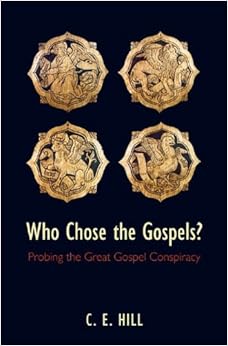
Who Chose the Gospels is a surprisingly entertaining and easy read given the difficult content. Hill smartly sasses his opponents in a humorous way, yet backs his views in true scholarship. If you are interested in Biblical scholarship or even ancient literature, this book is insightful.
Great book presenting the evidence for a four gospel canon of the Biblie since the early second century. Some conclusions come from speculation, but the author recognizes it and clearly shows that the evidence still fits.
Excellent book by a first-class scholar. Thoroughly researched, properly reasoned and very well-written, all in a concise text.
Excellent, well researched book that presents clear evidence for every assertion he makes. I bought several more of these to distribute to friends who have told me that the bible cannot be accurate since it is a continual retranslation of previous retranslations with the concomitant corruption that is sure to follow therefrom. This book dispels those ideas completely. And it makes clear that every translation of the bible has used the most accurate interpretation of the latest research. And it explains in great detail how that is accomplished.
Author surveys available literature from the relevant period and draws reasonable conclusion.It is pretty informative and well written book. I think it treats the historical material fairly and honestly.I think it gets harder to read toward end, but first chapters are hard to put down. I am not sure if that was me, or authors writing style..Whatever the case, if you really interested in the subject of who choose the Gospels, or which were the "candidates" and how many. As author says, there are some contemporary weird theories (which of course after reading this book, or looking at history objectively will simply fall apart) that say that Gospels where popping into existence like rabbits. Ancient writings like Gospel of Thomas, Gospel of Peter, etc etc are presented to general audience as legitimate competitors to Christian Canon. To see if this is the case, and why, let's not be lazy and read the book. ;)
The popularity of Dan Brown's "The Da Vinci Code" and a series of books by Bart Ehrman have had a significant impact on the way many people look at the history of early Christianity. (I should note that Ehrman has written a book about the errors and exaggerations of "The Da Vinci Code," so it's important not to see him as embracing many of the stranger claims in that book.) As I understand it, Ehrman has made two key claims:1. There were many books used by Christians in the first and second centuries. The books that eventually made it into the New Testament were chosen late -- during the fourth century -- and were chosen largely on the basis of their support for what had become orthodox Christian doctrine.2. The text of the New Testament as we have it reflects significant changes made to support orthodox doctrine.C.E. Hill's book addresses the first of these claims. Ehrman is an excellent writer and his books have been best sellers. So, the truth is that whatever the merit of Hill's arguments, he is unlikely to have nearly the impact that Ehrman has had. While I've found Ehrman's books to be interesting and informative, I've always had some doubts about his claims. The other early Christian books seem to contain much more material of a legendary nature -- this is particularly true of the non-cannonical Gospels -- compared with the books included in the New Testament. So, leaving aside all other considerations, they seem weak candidates to have been included in the New Testament. Similarly, although Ehrman can point to many changes that seem likely to have been made to the text of the New Testament, none of the changes seems truly central to the Christian message. So, I was looking for a book that directly addresses some of Ehrman's arguments written by someone with a strong grounding in the relevant texts and a knowledge of the academic literature.Hill makes a strong case that from a very early date, Matthew, Mark, Luke, and John were considered authoritative by Christian writers, largely because they were the Gospels that were associated with the Apostles or with their immediate followers. In fact, their connection with the Apostles was so strong that Hill argues no one needed to "choose" the Gospels because they were so widely believed to be handed down from the Apostles and their followers that they were from the late first century widely used by early Christian churches. Hence, by the fourth century, the church was simply ratifying their use, rather than choosing them from among many competing Gospels. Hill makes what seems to me to be an effective argument that the Gospel of Thomas, the Gospel of Judas, the Gospel of Mary, and other non-cannoncial Gospels were never accepted as authentic accounts of Jesus' life by any significant number of early Christians. Hence, Hill rejects the argument of Ehrman and others that the four Gospels were imposed on the Church by a conspiracy of orthodox writers and church officials.I lack the expertise to evaluate the evidence put forward by Hill on the one hand and by Ehrman and his supporters on the other hand. So, in that sense I run the risk of being convinced by whatever book I happen to have read most recently. But Hill's arguments seem convincing to me because they buttress the doubts about Ehrman's arguments that occurred to me as I was reading Ehrman's books.Hill writes well, although he does delve more than I think he needs to into the minutiae of different early Christian authors and what particular extracts from their work may or may not have meant in the context of their time. As I say, for the average reader, these arguments are difficult to evaluate. One of the keys to Ehrman's popularity, I think, is that he avoids burying the reader in too much detail. Hill doesn't quite hit the happy medium where the basis for the argument is presented, but the finer points are not gone into at excessive length. It's also evident that Hill sees himself as part of a beleaguered minority in the current academic debates and that he believes that those on the other side are pursuing a political agenda. This may well be true, but I think that bringing it up multiple times distracts the reader and weakens his case. Finally, although it's a minor point, Hill should pick up a copy of White and Strunk's "The Elements of Style" and read the section on when to use "which" and when to use "that." I would guess that he uses "which" when conventional usage indicates "that" should be used at least 100 times. A failure of copyediting at Oxford University Press, I would guess.Anyone who is interested in the ongoing debate over early Christianity should definitely read this book.
Buy this book and cut through the hype of current cultural undermining of the formation of the four gospel inclusion in the New Testament canon. Hill wonderfully interacts with any ultimately dismantles the claim that there were many "recognized gospel" used to scripture in the first century church. This is the only resource you need, if you are struggling to understand why the Gospels of Judas, Peter, Mary, etc... should be rejected as scripture.
PDF
EPub
Doc
iBooks
rtf
Mobipocket
Kindle

0 komentar:
Posting Komentar