Download Reason within the Bounds of Religion (PBK), by Nicholas Wolterstorff
One of the sources to obtain in this internet library is the Reason Within The Bounds Of Religion (PBK), By Nicholas Wolterstorff This site with this book becomes one of the finding out centres to get the resources and products. Lots of books from many sources, publishers, and authors from around the world are given. This solution will offer not just the support books, the referrals, literature, and also guideline books are offered to find out.
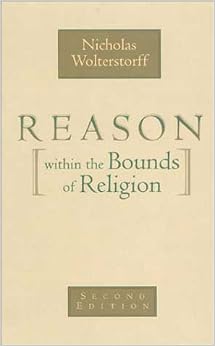
Reason within the Bounds of Religion (PBK), by Nicholas Wolterstorff

Download Reason within the Bounds of Religion (PBK), by Nicholas Wolterstorff
Show your great task making your life look much better. Wait, not just look far better but precisely great sufficient! Are you believing that many people will be so admired of you who have great behaviors? Naturally it can be one of the benefits that you can get when having that sort of leisure activities. And now, what concerning analysis? Is his your leisure activity? Well, reviewing publication is boring, will you think that so? Actually, that's not.
Investing the time for reading a book will give you the very helpful system. The system is not only regarding getting the expertise to associate with your specific problem. However, often you well need enjoyable point from guide. It could accompany you to run the time meaningfully as well as well. Yeah, good time to review a book, great time to have a good time. And also the existence of this book will be so accurate to be in your own.
When starting to check out the Reason Within The Bounds Of Religion (PBK), By Nicholas Wolterstorff is in the appropriate time, it will permit you to reduce pass the reading actions. It will be in going through the precise analysis style. Yet many people may be perplexed as well as careless of it. Also the book will reveal you the reality of life; it does not suggest that you could really pass the process as clear. It is to really supply the here and now book that can be one of referred publications to read. So, having the web link of the book to visit for you is extremely joyful.
Even the data of guide is in soft file, it doesn't mean that the material is different. It only differentiates through guide presented. When you have the soft file of Reason Within The Bounds Of Religion (PBK), By Nicholas Wolterstorff, you can extremely easy saving this data right into some specific gadgets. The computer system, gizmo, as well as laptop computers are suitable enough to save the book. So, anywhere you are, you can be available to establish the time to check out.
About the Author
Nicholas Wolterstorff is Noah Porter Professor Emeritus ofPhilosophical Theology at Yale University. Before going toYale he was Professor of Philosophy at Calvin College inGrand Rapids, Michigan, for thirty years.
Read more
Product details
Series: PBK
Paperback: 161 pages
Publisher: Eerdmans; 2 edition (June 1, 1988)
Language: English
ISBN-10: 9780802816047
ISBN-13: 978-0802816047
ASIN: 0802816045
Product Dimensions:
5 x 0.4 x 8 inches
Shipping Weight: 6.4 ounces (View shipping rates and policies)
Average Customer Review:
4.7 out of 5 stars
7 customer reviews
Amazon Best Sellers Rank:
#118,315 in Books (See Top 100 in Books)
Very scholarly... a bit more than I really wanted, but it was still a real good read.
Short and good.
Wolterstorff does his characteristic solid job of thinking and writing enabling us to engage the philosophical underpinnings of the challenges of epistemology in our contentious era.
Nicholas Wolterstorff (born 1932) is an American philosopher and theologian who is Professor Emeritus of Philosophical Theology at Yale University; he also helped to establish the journal ‘Faith and Philosophy’ and the Society of Christian Philosophers. [NOTE: page numbers below refer to a 115-page paperback edition.]He wrote in the Preface to this 1976 book, “The following is a tract for Christians. I welcome others to listen in. But Christians are the ones I am writing for. What I have written for them is a soliloquy of sorts. I ask what my own fundamental identity as a Christian has to do with my practice of scholarship and, more importantly, what it OUGHT to have to do with it… The general topic under consideration is religion and science… I am a philosopher, and my topic is a philosophical one… Yet I have written in the hope that persons other than philosophers will find it comprehensible and illuminating… My title is, as philosophy students may recognize, freely borrowed from Kant.â€He explains, “The Christian who is a scholar finds himself in two communities: the community of his fellow Christians and the community of his fellow scholars. Each has its own criteria for membership, its own characteristic practices, its own characteristic beliefs, its own characteristic training programs… if one who is a scholar as well as a Christian wants coherence in life… he cannot help asking, how does my membership in these two communities fit together? This is what I shall ask in the following pages. Part of my answer to this question will involve sketching out some elements of a theory of theorizing. The basic issue behind our question is that of the role of one’s Christian commitment in one’s practice of scholarship.†(Pg. 17)He states, “the main doctrine of the foundationalist is the normative rule that a person is warranted in accepting a theory at a certain time if and only if he is then warranted in believing that that theory belongs to genuine science… But would we be justified in requiring of the foundationalist a general criterion for determining when one is and when one is not warranted in believing so-and-so? I think not. In the first place, one can be warranted (and know that one is warranted) in believing so-and-so without having a satisfactory general criterion for warranted belief. I am surely warranted in my belief that I cannot jump to the moon. Yet I have no general criterion for warranted belief. So if everything else about the foundationalist’s criterion is satisfactory we can accept and use it even though he gives us no general criterion for warranted belief.†(Pg. 31)He observes, “as far as foundationalism is concerned, all probabilistic inductive arguments are equally untenable, for they all use a rule of inference that is neither known with certitude to be satisfactory nor known to be probably satisfactory. But this leaves us without any acceptable explanation of the relation theories bear to the foundation just in case they belong to genuine science. First it was demanded that a theory be probable with respect to the foundation. It turned out that none were.†(Pg. 36)He notes, “only in such ‘nonempirical’ disciplines as logic and mathematics do we have genuine ‘scientia.’ For only here do we have theories derived by satisfactory rules of inference from indubitables… the Euclidian model, in which a mathematical system is constructed by beginning with self-evidently true propositions and proceeding by the use of self-evidently satisfactory rules, has been left far behind. The mathematician and the logician today begin with axioms that are far from self-evident. Then they proceed to construct deductions which they hope will not yield propositions that are self-evidently false. Along the way the air of implausibility---and or arbitrariness to avoid paradox---is very thick indeed.†(Pg. 51)He summarizes, “On all fronts foundationalism is in bad shape… It is not the case that one is warranted in accepting some theory if and only if one is warranted in believing that it is justified by propositions knowable noninferentially and with certitude. From this it does not follow that there is no structured reality independent of our conceivings and believings… Nor does it follow that we must give up truth as the goal of theoretical inquiry… Nor does it follow that we can never know the truth… Nor does it follow that one belief is as warranted for me as another. All that follows is that theorizing is without a foundation of indubitables. Our future theories of theorizing will have to be nonfoundationalist ones.†(Pg. 52-53)He asserts, “Unsettling as it may be for many Christians, it must be firmly said that … the Bible also does not provide us with a foundation for theorizing. Reading and interpreting the Bible is not a procedure for arriving at propositions knowable noninferentially and indubitably to be true… It has ben assumed that … human knowledge generally---must have a foundation of certitude. What better source for such certitude for the Christian than the Bible… along with reflection and experience? Thoroughly considering this matter would … take us too far afield… it is enough to show that even if this view of Scripture were correct the Bible could not provide us with a foundation for theorizing.†(Pg. 54-55)He points out, “In weighing a theory one always brings along the whole complex of one’s beliefs. One does not strip away all but those beliefs functioning as data relative to the theory being weighed. On the contrary, one remains cloaked in belief.. For one thing, there will always be a large set of beliefs such that one’s holding them is a condition of one’s accepting as data what which one does. Let us call these ‘data-background beliefs’… That which the scientist takes as data he does so because of his acceptance of an enormously complicated web of theory… it is even more important to bring to attention a second component in the cloak of beliefs… Everyone who weighs a theory has certain beliefs as to what constitutes an acceptable SORT of theory on the matter under consideration. We can call these ‘control beliefs.’†(Pg. 63)He outlines, “My contention in what follows is that the religious beliefs of the Christian scholar ought to function as CONTROL beliefs within devising and weighing of theories. This is not the only way they ought to function…. Nor does that exhaust their function. But their functioning as control beliefs is absolutely central to the Christian scholar.†(Pg. 66)He elaborates, “The Christian scholar ought to allow the belief-content of his authentic Christian commitment to function as control within his devising and weighing of theories. For he like everyone else ought to seek consistency, wholeness, and integrity in the body of his beliefs and commitments. Since his fundamental commitment to following Christ ought to be decisively ultimate in his life, the rest ought to be brought into harmony with it… the Christian scholar ought to reject certain theories on the ground that they conflict or do not comport well with the belief-content of this authentic commitment. And positively he ought to devise theories which comport as well as possible with… the belief-content of his authentic commitment.†(Pg. 72)He acknowledges, “In some cases a Christian scholar and a non-Christian scholar may each justifiably accept a particular scientific theory… On the other hand, there may be less ‘shared ground’ than one might suppose at first glance… low-level theories in science often presuppose high-level theories. And it may well be… that unnoticed features of these high-level theories … make them unacceptable either to the Christian scholar or to some non-Christian scholar.†(Pg. 79)He clarifies, “Though authentic commitment ought to function as control within our theory-devising and theory-weighing, such activities will forever bear within them the potential for inducing… revisions in our views as to what constitutes authentic commitment, and thus, revisions in our actual commitment… A question which naturally comes to mind is whether scientific developments can produce changes in one’s authentic commitment… I think the answer must be Yes… The scholar never knows in advance where his line of thought will lead him. For the Christian to undertake scholarship is to undertake a course of action that may lead him into the painful process of revising his actual Christian commitment… It may, indeed, even lead him to a point where his authentic commitment has undergone change.†(Pg. 91-93)This book will be of great interest to those seriously studying philosophical theology.
You may have heard someone assert that religious people blindly hold onto their beliefs and ignore scientific facts. Indeed some religious people do this. However, It's a great fallacy to assert that only "religions" try to adapt to new data and sometimes interpret it in a way that minimizes its significance. In this short book Nicholas Wolterstorff's shows how scientists have argued (and do argue) amongst themselves about when and how to deal with data that seemingly contradicts their scientific beliefs. They have sometimes held onto their pet theories as stubbornly as if the afterlife were at stake! The tendency to be stubborn is not a flaw of the "religious" among us, but is a human tendency, period. Science remains to this day to be compatible with religious belief, in particularly Christian belief - for the data that have come in can be reasonably accommodated by the Christian worldview.
For someone new to Wolterstorff, this was a great introduction. I found that he is not only a brilliant philosopher, but an excellent writer as well! Without an adversarial attitude, he answers the question "what is the proper role of one's Christian (or otherwise religious) commitment in one's scholarship?" from an anti-foundationalist viewpoint. His "control belief" concept is intriguing and indeed easy to find in all facets of life, religious faith notwithstanding. For a logical and skeptical mind, this should be a very thought-provoking read! For further reading, check out Reasoned Faith: Essays in Philosophical Theology.
Reason within the Bounds of Religion (PBK), by Nicholas Wolterstorff PDF
Reason within the Bounds of Religion (PBK), by Nicholas Wolterstorff EPub
Reason within the Bounds of Religion (PBK), by Nicholas Wolterstorff Doc
Reason within the Bounds of Religion (PBK), by Nicholas Wolterstorff iBooks
Reason within the Bounds of Religion (PBK), by Nicholas Wolterstorff rtf
Reason within the Bounds of Religion (PBK), by Nicholas Wolterstorff Mobipocket
Reason within the Bounds of Religion (PBK), by Nicholas Wolterstorff Kindle

0 komentar:
Posting Komentar